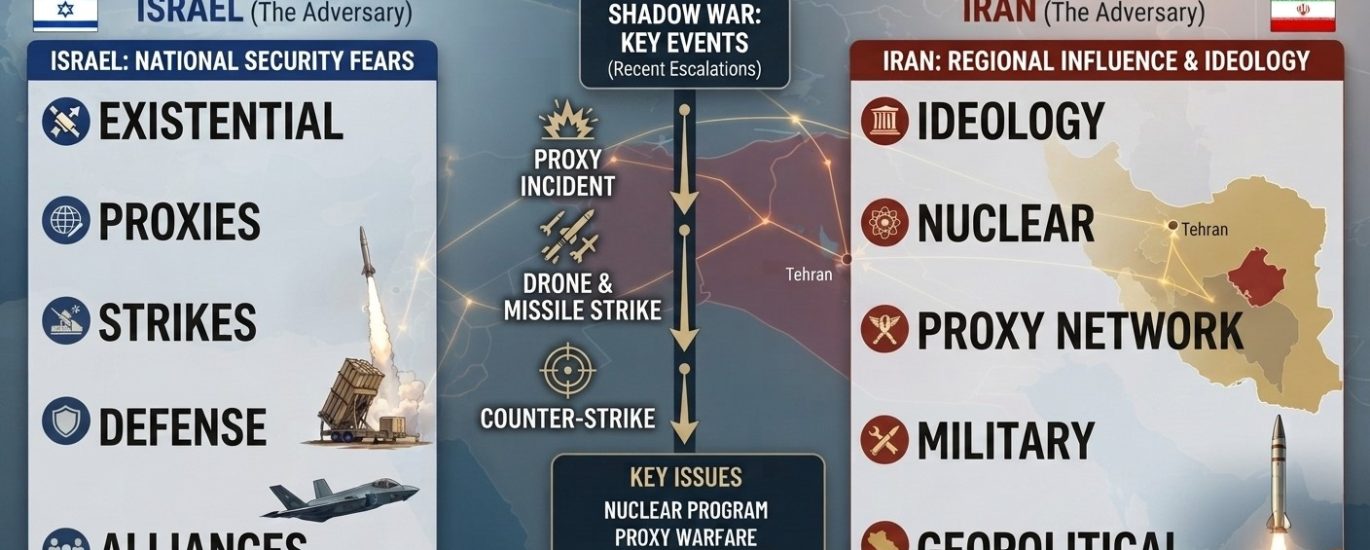
As tensions between Israel and Iran continue to dominate international headlines, the involvement of the United States has added another layer of complexity to one of the world’s most volatile geopolitical rivalries. Although the conflict has unfolded over several decades, recent military exchanges and diplomatic disputes have renewed global concern over the possibility of a broader regional war with far-reaching humanitarian, political and economic consequences.
At the heart of the conflict lies a long history of mistrust. Relations between Israel and Iran changed dramatically following the 1979 Iranian Revolution. Before the revolution, the two countries maintained relatively cooperative ties. However, after the establishment of the Islamic Republic under Ayatollah Ruhollah Khomeini, Iran adopted a policy of rejecting Israel’s legitimacy and expressing support for the Palestinian cause. Since then, diplomatic relations have remained absent, while political hostility has continued to shape their interactions.
Iran’s nuclear programme remains one of the most contentious issues. Iranian authorities maintain that the country’s nuclear activities are intended solely for peaceful purposes, including electricity generation, medical research and scientific development. Israel, the United States and several other governments, however, have expressed concern that Iran could develop the capability to produce nuclear weapons. Iran has consistently denied seeking such weapons, while international inspectors have monitored aspects of its nuclear programme under various agreements and verification mechanisms.
Regional security concerns have also intensified the rivalry. Iran provides political, financial and military support to armed groups, including Hezbollah in Lebanon and Hamas in Gaza. Israel, the United States and several other countries classify these organisations, in whole or in part, as terrorist groups because of attacks carried out against Israeli targets. Iran describes its support as assistance to resistance movements opposing Israeli occupation and foreign influence. These opposing perspectives have fuelled years of indirect conflict across the Middle East.